1 Welcome to Business Analysis
Before we dive into the material, I want you to know something important: this course was designed with you in mind. Whether you come from a background in finance, accounting, marketing, information systems, or any other business discipline, the skills you learn here will serve you throughout your career.
I hold a PhD in Information Systems with specializations in Systems Analysis and Design. My background also includes a BSc and MSc in Computer Science, with 20 years of experience spanning public sector software development and consultancy work.
I mention my background not to impress you, but to assure you that what you learn comes from someone who has lived these concepts. Every technique, every framework, every example in this course has been tested in real organizations solving real problems.
1.1 What This Course Is About
This course covers four interconnected areas that form the foundation of modern business operations. Business Analysis sits at the center, but you will also learn about the Product Owner role, Scrum Master responsibilities, and Software Testing fundamentals. These roles often work together in organizations, and understanding each one makes you more valuable in any of them.
But before we talk about Business Analysis, let me step back and ask a more fundamental question: What exactly is a business?
A business is any organization engaged in commercial, industrial, or professional activities. This definition covers a lot of ground. The corner coffee shop is a business. So is a multinational bank. A nonprofit hospital is a business. So is a government agency that processes passport applications. What unites all these organizations is that they take inputs, process them in some way, and produce outputs that serve customers or stakeholders.
Think about this for a moment. Every organization you have ever interacted with, from the university you attend to the streaming service you use to watch movies, follows this basic pattern. They receive something, they do something with it, and they deliver something to someone who values it.
1.2 Drivers of Business Change
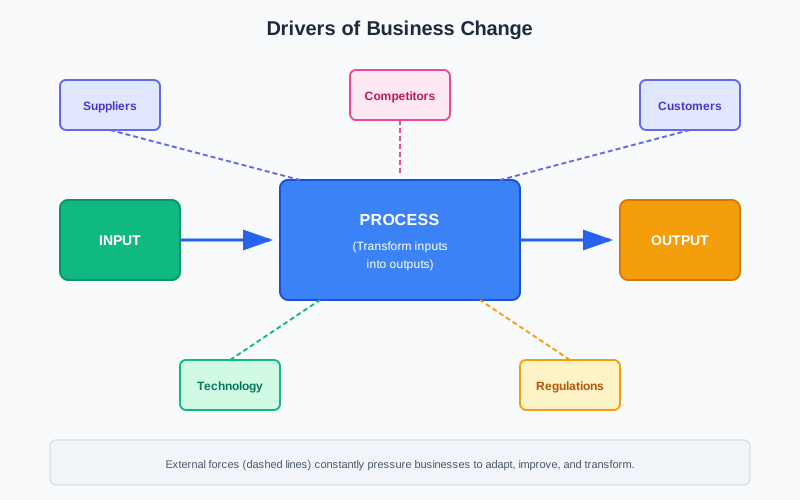
Look at Figure 1.1. At the center, you see the core business activity: taking inputs, processing them, and creating outputs. But surrounding this core activity are forces that constantly push businesses to change.
Suppliers provide the raw materials, services, and resources that businesses need. When suppliers change their prices, quality, or availability, businesses must respond.
Customers receive the outputs and decide whether they meet their needs. Their preferences evolve constantly.
Competitors offer alternatives that might serve customers better or cheaper.
Technology creates new possibilities and makes old approaches obsolete.
Regulations impose rules that businesses must follow.
Here is the key insight: these forces never stop. They create constant pressure on organizations to adapt, improve, and transform. This is where Business Analysis enters the picture.
1.3 What Is Business Analysis?
Business Analysis is the practice of enabling change in an enterprise. Read that sentence again. It is not about writing documents. It is not about attending meetings. It is about enabling change.
When an organization faces a problem or sees an opportunity, someone needs to figure out exactly what needs to happen. What does the organization actually need? What solutions might work? How can we describe the solution clearly enough that others can build it? These questions define the work of Business Analysis.
More specifically, Business Analysis involves defining needs and recommending solutions that deliver value to stakeholders. It means articulating why change is necessary and describing what that change should look like. Notice that I say “describe” the solution, not “build” the solution. Business Analysts are translators and architects of ideas, not necessarily the people who construct the final product.
1.4 Why Should You Care?
Let me be honest with you. You are investing time and effort in this course. You deserve to know what you will get in return.
First, consider the career opportunities. Business Analysts, Product Owners, Scrum Masters, and related professionals are in high demand across every industry. Organizations need people who can bridge the gap between what the business needs and what technology can provide. This need is not going away. If anything, it grows as technology becomes more central to every aspect of business.
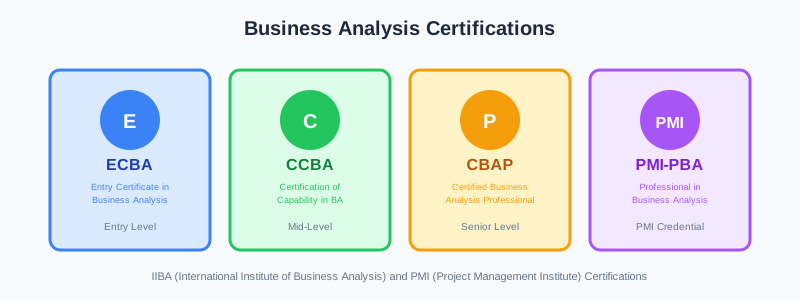
Second, this course prepares you for professional certifications that employers recognize and value. Figure 1.2 shows the certifications you can pursue: the Entry Certificate in Business Analysis (ECBA), the Certification of Capability in Business Analysis (CCBA), the Certified Business Analysis Professional (CBAP) designation, and the PMI Professional in Business Analysis (PMI-PBA) credential. These certifications can open doors and increase your earning potential.
Speaking of earnings, let me talk about compensation. Business Analysts earn competitive salaries that grow significantly with experience. Entry-level positions typically start around $69,000 USD annually in the United States, while senior professionals can earn over $100,000 USD. Similar patterns exist in the UK, Canada, and other markets, adjusted for local conditions.
But beyond money and credentials, there is something deeper. The ability to analyze problems, communicate clearly, and facilitate solutions makes you valuable in any role. Even if you never hold the title “Business Analyst,” these skills will help you as a manager, an entrepreneur, a consultant, or any other business professional.
1.5 How This Course Is Organized
Your learning follows a logical progression that mirrors how Business Analysis work actually happens in organizations.
We begin with fundamentals, building a shared vocabulary and understanding of what Business Analysts do. Then we move to strategy, where you learn how organizations identify problems worth solving. The initiation and planning phase covers how Business Analysis work gets organized and managed. Requirements elicitation teaches you how to gather information from stakeholders. Requirements management addresses how to organize, track, and control that information over time. Requirements analysis and design shows you how to transform raw information into useful models and specifications. Finally, we explore Agile methods, particularly Scrum, which has become the dominant approach for many organizations.
Throughout this journey, you encounter teaching sessions, training exercises, question and answer sessions, assignments, quizzes, projects, and seminars. Each element reinforces your learning in different ways.
1.6 How to Use These Notes
These notes accompany the slides you see in class. Think of them as a conversation between us. The slides present key concepts visually. These notes explain those concepts in depth, provide examples, and offer guidance that helps you truly understand rather than merely memorize.
I encourage you to read the relevant sections before class, review them after class, and return to them when working on assignments. Highlight passages that resonate with you. Write questions in the margins. Treat this as a working document, not a pristine artifact to be preserved untouched.
Learning is not a passive activity. It requires your engagement, your questions, and your willingness to struggle with ideas until they become clear. I am here to guide you, but ultimately, the learning happens inside your mind.
1.7 Case Example: Why Business Analysis Matters
Consider Maria, an accounting major who graduated two years ago. She took a job at a mid-sized manufacturing company, expecting to spend her days working with financial statements and audit procedures. Within six months, her manager asked her to help with a new project: the company was implementing a new inventory management system.
Maria had no formal training in technology or systems analysis. But she understood the business. She could explain what information the accounting department needed from the inventory system. She could describe how the current process worked and where it failed. She could ask the right questions when the software vendor proposed solutions.
Without knowing it, Maria was doing Business Analysis. She was translating between what the business needed and what the technology team was building. Her accounting background made her valuable precisely because she could explain the business context that the technical people did not understand.
Today, Maria leads a small team that handles all system implementations for her company. She has earned her CBAP certification and regularly mentors new employees who, like her former self, find themselves thrust into Business Analysis work without formal training.
Maria’s story is common. The skills you learn in this course prepare you for opportunities you may not even see coming yet.
Now that you understand why Business Analysis matters, let us move on to explore what Business Analysts actually do on a daily basis.
1.8 Review Questions
Which of the following best describes the primary purpose of Business Analysis?
- Writing detailed technical documentation for software developers
- Enabling change in an enterprise by defining needs and recommending solutions
- Managing project budgets and timelines
- Testing software applications before release
According to the course material, what are the five external forces that drive business change?
- Employees, Managers, Executives, Shareholders, and Board Members
- Suppliers, Customers, Competitors, Technology, and Regulations
- Marketing, Finance, Operations, Human Resources, and Information Technology
- Planning, Organizing, Leading, Controlling, and Evaluating
Which professional certification represents the entry level for Business Analysis?
- CBAP (Certified Business Analysis Professional)
- PMI-PBA (Professional in Business Analysis)
- ECBA (Entry Certificate in Business Analysis)
- CCBA (Certification of Capability in Business Analysis)
The course material emphasizes that Business Analysts are best described as:
- Programmers who also understand business requirements
- Translators and architects of ideas who describe solutions
- Project managers with additional technical skills
- Quality assurance specialists focused on testing
What is the basic pattern that all businesses follow, regardless of their size or industry?
- Plan, Do, Check, Act
- Input, Process, Output
- Define, Measure, Analyze, Improve, Control
- Initiate, Plan, Execute, Monitor, Close
1-b, 2-b, 3-c, 4-b, 5-b